Free consultation · reply within 1 business day
CRO, Funnels & Analytics
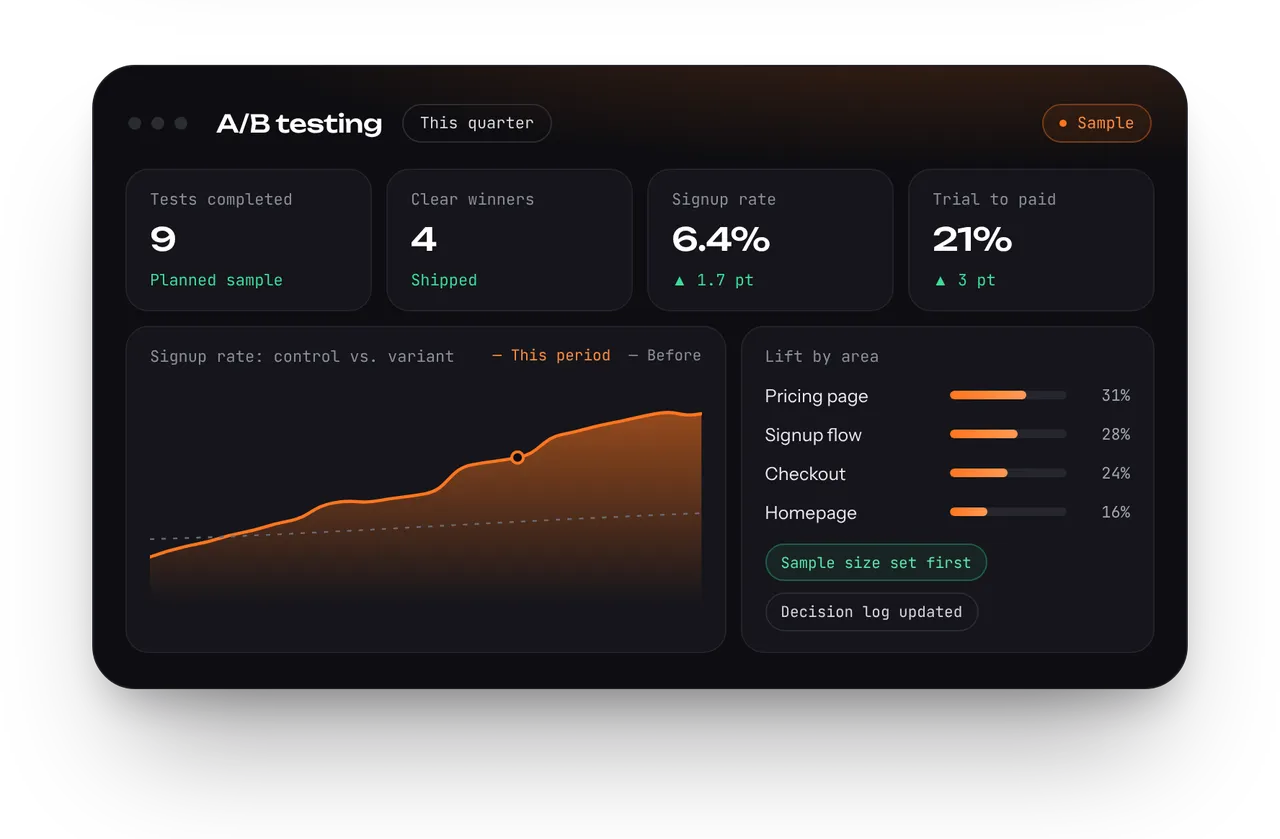
Most startup “tests” are a new headline, a week of watching the dashboard and a decision made on forty conversions. That is how teams ship changes that made things worse. We choose what to test from evidence, set the sample size first, and tell you when a result is real and when it is noise.
Free audit, no obligation · Written 30-day GTM and CAC roadmap · Reply within one business day
Tell us where growth is stuck. We reply within one business day and send a written 30-day GTM and CAC roadmap.
Trusted by brands like






Problems we solve
What growth teams say about experiments.
We run everything for a week and call it.
A variant won by 20% and nothing changed after we shipped it.
The loudest person in the room picks the design.
We get 3,000 visitors a month and want to test ten things.
We set prices on day one and have never tested them.
The page flickers before the variant loads.
People keep proposing tests we already ran.
We test button colors because bigger changes need engineering.
Half of buyers leave at payment and we do not know which step.
Two teams ran overlapping tests and ruined both.
We cannot tell whether the free tier helps or hurts.
Typical of what business owners tell us when they first get in touch.
Built for startups
An established business has years of data, a known name and a budget set a year ahead. A startup has none of these, and growth usually has to be paid for from revenue.
Split testing is built for sites with heavy traffic. Most startups do not have it, so we say so, test large differences instead of button colors, and use interviews and recordings where the numbers are too thin.
Tests run with the experiment feature of tools you already have or simple feature flags. No enterprise testing suite.
With low traffic a bold change is shipped and read against the weeks before it. Formal tests are saved for the few places with enough volume.
Already trading for years, with history to analyze and a steady budget? That is a different job.
What's included
Fewer, better tests, each with a written decision.
Analytics, recordings and user feedback turned into ranked test ideas.
Primary metric, minimum effect and required traffic calculated before launch.
Variations built in your testing tool or behind feature flags.
Layout, plan names, anchoring and annual options tested with care.
Steps, fields and friction tested across the flow.
Each test written up with the result, confidence and what ships.
How it works
01
We review funnel data and recordings and list hypotheses by expected impact.
02
You get a test roadmap with sample sizes and durations.
03
Variants are built, quality-checked and launched.
04
We call each result at the planned sample size and document it.
01
Funnel reviewed; what can and cannot be tested stated.
02
First large-change test or before-and-after read.
03
One decision logged every two to three weeks.
Typical timings. Yours depend on budget, market and where you start from.
Your traffic is too low for testing. With a few hundred visitors a month, user interviews and bold changes teach more than A/B tests.
Why Nothing Marketing
Stopping a test the moment it looks good is the most common mistake in testing, and it produces wins that vanish in production. We fix the rules in advance and report inconclusive results as inconclusive. A smaller number of trustworthy answers beats a long list of false ones.
FAQs
Cost, timing and what A/B Testing involves, answered plainly. Ask anything else in your free audit.
As a rough guide, a few hundred conversions per variant. Below that, only large effects can be detected. We calculate it for your funnel before proposing a test.
Yes, carefully. Page layout, plan names and which plan is highlighted are safe to test. Showing different prices to different visitors raises fairness and legal questions, so we usually test over time or by market.
A/B compares whole versions and needs less traffic. Multivariate tests combinations of elements and needs far more. Most startups should run A/B tests.
Whatever fits your stack: a dedicated testing tool, your product analytics’ experiment feature or feature flags in code. We avoid tools that slow the page.
Split testing is built for sites with heavy traffic. Most startups do not have it, so we say so, test large differences instead of button colors, and use interviews and recordings where the numbers are too thin. If you already have that history and a steady budget, our CRO service is the better fit.
The startup growth audit is free. After it we quote a fixed fee for the scope you need, before any work starts. Where there is media spend, you pay it directly to the platforms.
Related services
Dedicated campaign pages built for speed and conversion.
Fixing free-trial, freemium-to-paid, and onboarding drop-offs.
B2B lead qualification and calendar booking velocity.
GA4, Meta CAPI, Google Enhanced Conversions, and UTM governance.
Event tracking in Mixpanel, PostHog, and Amplitude.
Live dashboards tracking CAC, LTV, ROAS, and MRR.
Optimize your marketing
Share analytics access or your key funnel numbers. We tell you whether you have the traffic to test, and which three tests we would run first.
You send your website, your stage and where growth is stuck.
We reply with a few questions or a time for a short call.
You get a free audit and a written 30-day GTM and CAC roadmap. You decide if we go further.
Tell us where growth is stuck. We reply within one business day and send a written 30-day GTM and CAC roadmap.
